Quick answer for curious homeowners: Vastu is not a modern scientific discipline, but many of its original principles align closely with climate responsive architecture, passive cooling, daylight planning, and human comfort. The challenge lies in separating practical design guidance from later cultural additions.
The Historical Context of Vastu Shastra
India has a long tradition of developing knowledge systems shaped by observation of nature. Concepts such as zero in mathematics, preventive health in Ayurveda, and climate responsive town planning demonstrate a deep understanding of environment long before modern scientific frameworks existed.
Vastu Shastra emerged within this context. Referenced in classical architectural treatises such as the Mayamata and Samarangana Sutradhara, it functioned as a planning guide for buildings that worked with sunlight, wind, terrain, and water rather than against them. In an era without electricity, artificial lighting, or mechanical ventilation, survival and comfort depended entirely on environmental design.
Homes needed to stay cool in summer, dry during monsoons, and well lit during the day. Vastu provided a systematic way to achieve this using orientation, spatial hierarchy, and material choices. At its core, it was less about mysticism and more about livability.
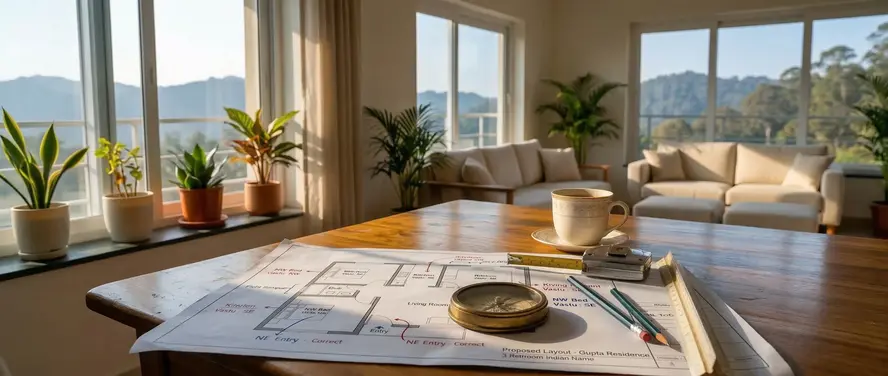
Why Many Vastu Recommendations Make Practical Sense
When viewed through the lens of modern building science, several traditional guidelines appear remarkably logical.
Sunlight and Orientation
The preference for east facing openings aligns with receiving gentle morning sunlight while avoiding harsh afternoon heat from the west. In tropical climates, western exposure can significantly increase indoor temperatures, making cooling difficult without modern technology.
Natural Ventilation
Traditional layouts often encouraged windows on opposite walls, enabling cross ventilation. This airflow helped remove heat, smoke, humidity, and indoor pollutants — essential in homes that relied on wood or coal for cooking.
Kitchen Placement
Locating kitchens where prevailing winds could carry smoke away from living areas was not symbolic. It was necessary for respiratory health and comfort.
Water and Drainage Considerations
Guidance on slopes and water flow helped prevent stagnation, dampness, and structural damage, especially in regions with heavy rainfall.
These elements closely resemble principles now used in sustainable architecture and passive design.
How Symbolic Layers Entered the System
Over centuries, as social structures evolved and construction technologies changed, additional interpretations accumulated. Some were influenced by astrology, some by local customs, and others by religious symbolism.
Because much knowledge was transmitted orally rather than standardized through controlled experimentation, practical rules gradually blended with belief based explanations. This helps explain why different consultants may offer conflicting advice for the same property.
In modern urban housing, strict directional prescriptions often clash with structural realities, building codes, shared walls, and land constraints. Homes today rely on artificial lighting, mechanical ventilation, and advanced materials, which reduces dependence on orientation alone.
What Actually Affects Comfort in Modern Homes
Regardless of Vastu alignment, certain factors consistently determine how livable a home feels:
- Access to natural daylight
- Thermal comfort throughout the day
- Adequate ventilation
- Privacy and noise control
- Efficient circulation between spaces
- Structural safety and maintenance
These elements influence sleep quality, mood, productivity, and overall well being. When a home performs poorly in these areas, residents may attribute discomfort to Vastu even when the underlying causes are environmental or psychological.
Vastu as a Traditional Design Language, Not a Predictive Science
The most balanced perspective is to treat Vastu as a historical framework for organizing space rather than a deterministic system that controls outcomes. Its original intent was to help people build homes that felt stable, comfortable, and aligned with natural conditions.
In this sense, Vastu contains genuine environmental wisdom. However, not every rule needs rigid application, especially when compliance requires expensive structural changes or creates unnecessary anxiety.
Vastu works best as guidance for good design, not as a checklist that determines success or failure.
Why Vastu Still Influences Property Decisions
Large investments such as home purchases naturally trigger a desire for certainty. Cultural familiarity, family expectations, and psychological reassurance all play a role in keeping Vastu relevant.
Even when buyers do not fully believe in it, they may consider it to avoid future regret or resale concerns. Understanding which aspects improve livability and which are symbolic helps families make more confident decisions without undue stress.
Practical Way to Use Vastu Today
For modern flats, villas, and urban homes, the most useful approach is selective application:
- Prioritize light, airflow, and functional layout
- Avoid drastic modifications unless clearly beneficial
- Focus on maintenance and structural quality
- Treat symbolic remedies cautiously
- Evaluate the home as a whole rather than one feature
This approach respects tradition while remaining grounded in practical realities.
Frequently Asked Questions
Is Vastu scientifically proven?
Not in the modern experimental sense. However, many underlying principles align with climate responsive architecture and environmental design.
Can a home without Vastu compliance still be comfortable?
Yes. Comfort depends more on design quality, ventilation, lighting, and maintenance than orientation alone.
Why do opinions about Vastu differ so much?
Interpretations evolved over centuries and vary across regions, traditions, and practitioners.
Final Perspective
Vastu Shastra occupies a middle ground between science and cultural tradition. It is neither pure superstition nor a precise predictive discipline. At its best, it offers time tested insights into building design that responds to climate, geography, and human needs.
Returning to this practical core allows homeowners to benefit from its strengths without being constrained by fear or myth. Ultimately, a well designed home that supports comfort, safety, and daily life will matter far more than strict adherence to any single traditional framework.